Outlook has been down since yesterday. Down for a lot of people, in a lot of countries, for two days running.
Microsoft's status page named Exchange Online, Teams, SharePoint, Copilot and Defender XDR. Outlook reports on Downdetector peaked near 140,000 on Thursday. The BBC reported no sign of a cyberattack. Microsoft said a number of servers went "unexpectedly unavailable" and strained the systems still running.
One company. One bad morning. A big slice of the working world stopped.
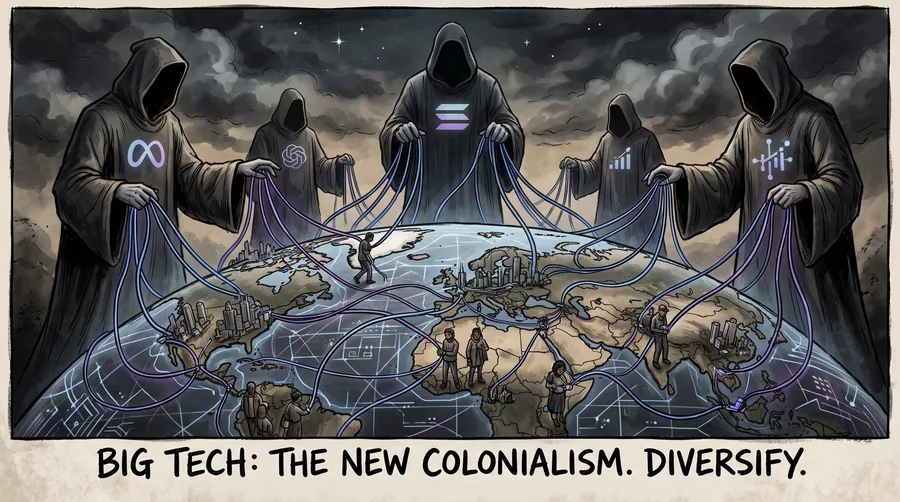
That is the argument in one outage. Tech monopolies are not mainly a pricing problem. They are a single point of failure that all of us agreed to share. We agreed for good reasons. It was cheaper. It was easier. Everyone else was doing it.
Then it breaks.
What the Banana Effect Says About Tech Monopolies
Bananas are clones. The Cavendish in the grocery store is grown from cuttings, so every plant is genetically the same plant.
That worked until it didn't. The Gros Michel, the banana that tasted like banana candy, was nearly wiped out by Panama disease in the middle of the 20th century. The industry switched to the Cavendish, which is now in the same trouble from a strain called TR4. A fungus that kills one Cavendish kills all of them.
Apples work the same way. A Granny Smith is a Granny Smith because someone grafted a branch onto rootstock, so every Granny Smith tree is a copy of the same tree. One pest that beats that graft beats the whole variety.
That is a monoculture. Efficient, uniform, and carrying one immune system for everybody.
Software is a monoculture too. The same operating system on the desktop. The same browser engine drawing the page. The same cloud behind the checkout. The same mail server holding the email.
The attack does not have to be a fungus. It can be a bad update, an expired certificate, a routing rule, or one tired engineer pushing to production on a Thursday.
When the Company Is the Government's Lever
A monopoly that only overcharged would be a nuisance. The real problem is what a company can do once the whole world is plugged into it.
Ukraine. In October, SpaceX capped Starlink and Starshield terminals moving faster than about 100 miles per hour, which cut off drones. Service came back on Oct. 24. On Nov. 12, President Zelensky said the cap was back at 161 kilometers per hour along the front line and over occupied territory, and that Ukrainian interceptors could no longer catch Russian jet-powered drones. SpaceX says nothing changed. The October cap landed while Washington was pressing Kyiv over strikes on Russian oil refineries.
Whatever the order was, and whoever gave it, the switch sat in one company's hands.
The ICC. In February 2025, the Trump administration sanctioned Karim Khan, the chief prosecutor of the International Criminal Court, after the court issued an arrest warrant for Benjamin Netanyahu. In May, the AP reported that Microsoft had cancelled Khan's email address, and that he moved to Proton Mail. Microsoft disputes the word cancelled. The company says the ICC chose to suspend his account after being told the alternative was losing email for the entire court, and it later corrected a spokesperson who told Parliament otherwise.
Take either version. A US contract term did the work of a US executive order, and the chief prosecutor of a war crimes tribunal lost his inbox. The ICC confirmed in October 2025 that it is moving off Microsoft Office to a European open source suite.
Australia. In February 2021, Meta blocked news on Facebook in Australia to fight a law that would have made it pay publishers. The block also took out state health departments and emergency services. Meta restored news after the law was amended.
Not one of those was a hack. No malware, no tanks. A terms of service decision, made in a boardroom, with no appeal and no notice.
The Numbers Behind the Monoculture
- Google handled 91.05% of worldwide search referrals in October 2026, per StatCounter. On mobile the figure is 96.35%.
- Windows runs about 74.6% of desktop traffic in 2026, per the same source.
- Microsoft says 430 million people use Microsoft 365 apps, and more than 90% of the Fortune 500 rely on its enterprise and AI tools.
A market that concentrated stops behaving like a market. It becomes a utility with a share price.
Utilities fail. In July 2024, a faulty CrowdStrike update took down 8.5 million Windows machines and grounded flights. In October 2021, a DNS change at Facebook pulled Facebook, Instagram and WhatsApp off the internet for about six hours. Both were accidents. Nobody had to intend harm for millions to lose a day of work.
Culture is the part people skip. When one feed decides what a billion people see, that company sets the agenda. Not by conspiracy. By default.
Why "Just Switch" Is Not an Answer
If you do not like it, use something else.
Switching is not free. Your files are in their format. Your invoices, contracts and integrations all point at their endpoints. The moat is not that the product is unbeatable. The moat is that leaving costs more than staying.
I have recommended Linux for years, and I will keep recommending it. It is not a religion and it is not for everyone. It is a second immune system, and the second immune system is the whole point.
Same for everyday software. The second most popular tool is usually good enough, and it is much easier to walk away from.
What I Tell Store Owners
I work on Shopify stores, so I will keep this practical. You cannot diversify your way out of every dependency. Shopify is the platform, and that is fine. You can make sure one outage, one app, or one vendor cannot take the whole business down with it.
- Export the catalog on a schedule. Products, customers, orders. Keep the file somewhere you control.
- Own the domain and the DNS. Registrar, DNS host and admin login should not all live with the same vendor as the store.
- Give the business a second mailbox. If email shares a tenant with everything else, an outage locks you out of your own support queue.
- Know which apps touch money. Payment, tax, shipping, checkout. Write down what breaks if each one vanishes.
- Read the offboarding page before you install. Export, cancel, delete. If the docs are silent about it, that silence is the answer.
- Test the spare. A backup you have never restored is a hope, not a backup.
On policy I am not subtle. Regulations should be written to discourage monopolies, not to admire them. Interoperability, data portability and rules against self-preferencing do more good than another hearing.
The Part I Am Not Sure About
I do not know whether the Starshield cap came from SpaceX, from the US government, or from something upstream of the terminal. SpaceX denies the November change and Ukraine says the disruption is real. Both can be true.
I also have no idea how you regulate a company that is a launch provider, a satellite network and a defense supplier at the same time. Nobody does. That is the honest state of it.
What I do know is that a system where one vendor's decision reaches a battlefield, a courtroom and a news feed is too concentrated to be safe.
Bananas Taste the Same Everywhere
That is the problem.
If your store, your email, or your whole working day depends on one company having a good morning, book a call with me. We will map the exits before you need them.
Written by Dana Lee Gibson. Shopify development, speed, and technical SEO.
More posts