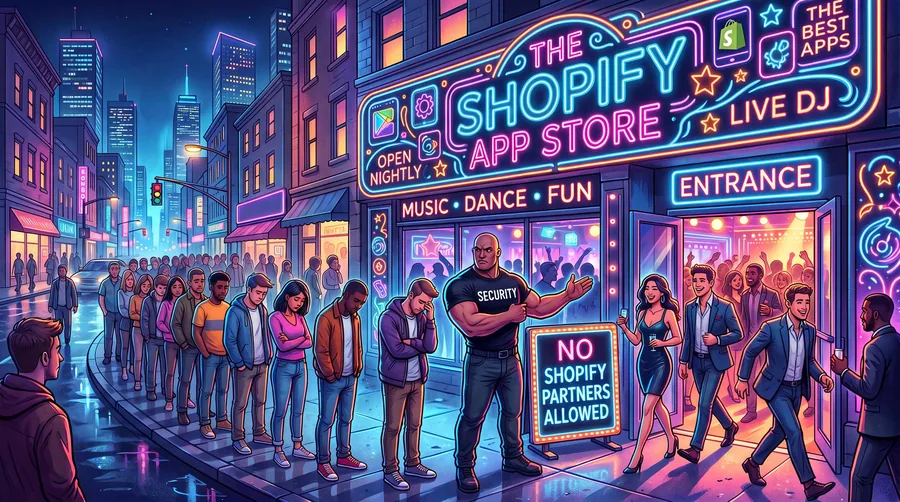
There's something I've never understood about the Shopify App Store.
To leave a rating or a comment on an app, Shopify says the app has to be installed on your active store. No install on your own store, no review. That is the rule as written.
It sounds reasonable. Then you look at who it blocks, and it stops sounding reasonable.
The rule, and the logic behind it
The stated reason is trust. If anyone could rate an app, the reviews would fill up with bots, paid shills, and people who never touched the product. The App Store would become a war zone of fake five stars and fake one stars.
That is a real problem. Nobody wants that.
But the rule does more than stop bots. It also silences the exact people who know these apps best. The rule solves a fake review problem by deleting real ones. That is a bad trade.
Who Shopify blocks without meaning to
Shopify reports more than 700,000 registered Partners worldwide. That is not a niche group. It is enormous.
Plenty of those Partners work as Collaborators on merchant stores. They install apps, configure them, and rescue the store when a checkout breaks. They touch more Shopify apps in a single month than most store owners touch in a year.
Here is the catch. When a Partner works on a client's store, the app is installed on that client's store. Not on the Partner's own active store. So the Partner reads the terms, sees their situation does not qualify, and walks away.
Their experience is blocked by a technicality. The person who set up the app cannot say a word about it.
The experience we are quietly throwing away
Think about who actually uses these apps and how often.
A store owner installs a handful. A developer installs dozens. A technician hunting a slow checkout might open and test ten apps in a single week, just to find which one drags the page down.
That is not a guess. That is the job. Testing apps means reading their Liquid, watching their scripts load, and measuring what they add to the page. The people who troubleshoot this stuff all day have a depth of practical knowledge no store owner can match.
That knowledge is being purposefully muffled. It is shady at worst and negligent at best. Pick whichever word you want, the outcome is the same.
What a Partner actually sees
The technical side is where the real value hides, and it is the part a normal review never captures.
When I test an app I look at the page weight it adds. I look at whether its script is render-blocking. I look at how it touches the theme's Liquid and whether it survives a theme update. I check whether the developer answers support tickets or ghosts you.
A store owner rates an app by whether it mostly worked. That is useful. But it misses the half of the story that determines whether the app is a gift or a slowly-growing problem.
Partners see that half. They are exactly the people who should be talking, and they are the one group told to stay quiet.
Take a simple example. Two apps do the same job, and both work. One loads a single lightweight script. The other pulls in a heavy script that blocks the page on mobile. A store owner gives both five stars. A Partner sees one is a slow-motion problem and says so. That is a distinction the current rule deletes from the record.
Flag them, do not block them
There is a clean fix, and it protects the trust the App Store needs.
Let Partners leave ratings and comments. Just mark them as coming from a Partner. That is it.
The label does the work Shopify is worried about. A "Partner review" badge tells store owners who is talking and lets them weigh it however they like. Review platforms do this all the time. Verified buyer. Verified reviewer. Same idea, same value.
It is also easy to build. The App Store already knows which account an app is installed under. Flagging the account as a Partner account and showing the badge is a few lines of logic, not a redesign.
Make it public and opt-in
Shopify could take it further, and the payoff is bigger than it sounds.
Let a Partner opt in to making their review and comment history public. Now their whole App Store activity becomes a track record. You can see how many apps a Partner has tested, which ones they liked, which ones they warned against, and how specific their feedback is.
That public history turns the App Store into a hiring tool.
Looking for a Shopify Partner? See who actually shows up in the ratings. See who comments with real detail, who names a performance problem, and who just writes something generic. Active Partners leave a trail of proof. Right now that proof is hidden from anyone trying to hire.
It does not mean it gets gamed
Would some Partners use the system to shill? Sure. A few people game every system that ever existed.
But a labeled, public, opt-in history changes the stakes. Fake it once and your entire record carries the stain. The label keeps the honest ones honest, and the public history makes dishonesty visible.
Compare that to the current approach, where the fix for fake reviews is to block everyone. It removes the noise by removing the signal. That is throwing out the baby with the bathwater.
Where it comes down
Shopify built the App Store on the work of its Partners. The same Partners install, configure, and rescue the stores that run the app ecosystem. Telling them they cannot speak about the work they do every day is a strange way to treat the people who carry the platform.
Partners are some of Shopify's most loyal and most active customers. The rule quietly turns them into spectators on a platform they built. That is not how you get good software.
Let them review the work they already test for free. Everyone gets better Shopify App Store reviews. Shopify just has to label them.
That is the whole fix.
In the meantime, if you are weighing any app, ask the person who installed it what they really think. If you want help choosing, testing, or fixing the apps on your store, that is the work I do. Reach out and let's look at your setup.
Written by Dana Lee Gibson. Shopify development, speed, and technical SEO.
More posts